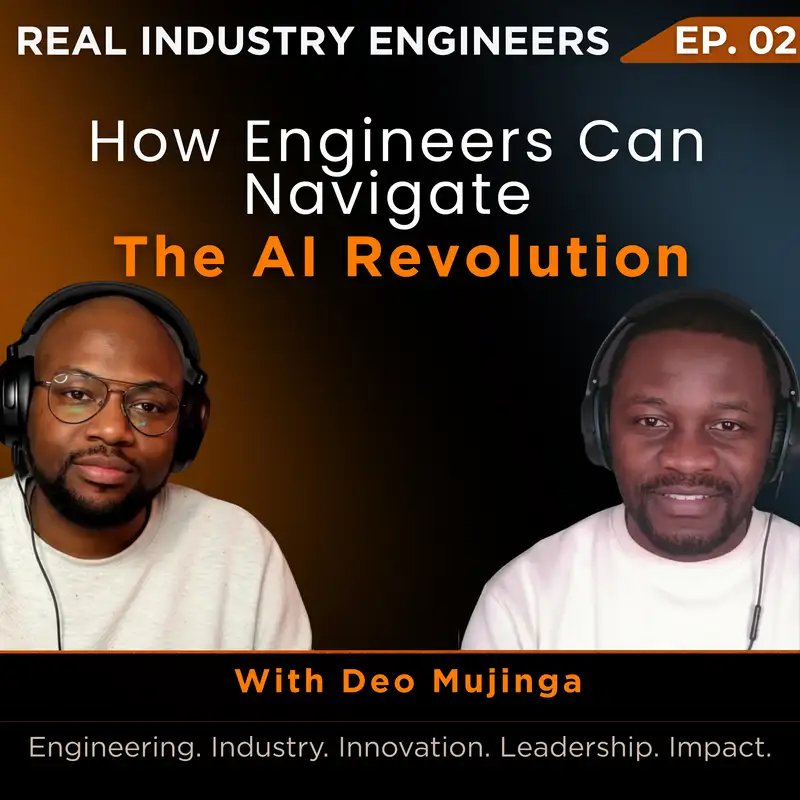
How Engineers Can Navigate this AI Revolution | Deo Mujinga | EP.002
Deo Mujinga (00:00)
I was always business-minded as much as I was
is AI moving quickly? And I think the answer is unequivocally yes.
I guess the first question we could ask here is what is artificial intelligence? That's a good place to start.
So once you get into this, because you want to build LLMs, by the time you're done doing your masters and your doctorate whatever it is,
Nyasha Pawandiwa (00:23)
Yeah, yeah.
Deo Mujinga (00:24)
LLM is probably old news at that point, right?
just being intrinsically true to yourself and what makes you tick Right. So what really makes you tick and then once you intrinsically true to yourself
I think the rights kind of just falls into place there.
the the answer is should you go to school absolutely right? Should you do software engineering? Yes, why not?
And I think after you've gotten all that, you know, come into the industry or you you start writing or you start programming. One of the things that you want to be able to do
Nyasha (00:59)
In today's episode, I'm joined by Deo Mujinga Deo is a solutions engineer and AI specialist focused on agentic AI. He helps organizations take AI ideas and turn them into real systems that actually work in the real world.
So for those joining me for the first time, my name is Nyasha and this is the Real Industry Engineers podcast
let's jump in.
Nyasha Pawandiwa (01:27)
Introduce yourself like I know you're sort of in the IT space. That's why you started off in and things like that. So me a little bit about that and sort of how your career journey has sort of been till now.
Deo Mujinga (01:41)
so quick background here ⁓ again, Deo Mujinga is a name ⁓ from South Africa initially what I did my studies over there ⁓ what I studied I studied ⁓ I studied several things ⁓ I did a few things ⁓ the first the first thing at least the first
degree that I got was in information technology. So I went to school, I did IT, and then after I completed that I thought, when was that? This was in 2011, 2010, 2010, that's when I started. And then I completed that.
Nyasha Pawandiwa (02:16)
When was it?
2011 2010 that's when you started
Deo Mujinga (02:33)
And then after that, I thought, hey, look, you know, well, because I worked for a little bit. I did a little bit of IT. I was an IT technician. I was dealing with databases and things like that. And then I thought, well, I'm starting to see myself talking to business people a little bit. So I like the idea also.
Nyasha Pawandiwa (02:46)
Yep, yep.
Mmm.
Deo Mujinga (03:01)
of being in the boardroom. when ⁓ all these, not necessarily investors, but talking to all these leaders about what's the trajectory of our business and how do we bring IT into this and all of that. So I went back to school. I did ⁓ business studies. ⁓ What was it called? It's like...
Nyasha Pawandiwa (03:03)
Mmm.
Mmm, yeah. Yeah, yeah.
Hmm?
Deo Mujinga (03:29)
It's like a sister to an MBA. think it's a diploma in, it's a postgraduate diploma in business management. I did that ⁓ in South Africa at Stellenbosch Business School. And then once I was done with that, ⁓ know, started a little bit more. ⁓
Nyasha Pawandiwa (03:40)
Gotcha.
Deo Mujinga (03:52)
I mean worked a little bit more and then realized that at the time, this was now in the year 2018 around, I realized that the industry was moving into a direction in which I wanted to go in.
Nyasha Pawandiwa (04:01)
Yep. Yep.
Mm.
Deo Mujinga (04:10)
So I also needed to fuse the business acumen and the technical acumen that I had. So at that point I was already programming, so was like a programmer, was like a .NET full-on programmer. ⁓ But I had done those business studies and then I figured, hey, I'm not gonna put it to waste, I need to bring the two together.
Nyasha Pawandiwa (04:17)
Yep. Yep.
Yep.
Yeah, yeah, yeah.
Deo Mujinga (04:33)
where is that place and that joint place where I can kind of bring business studies and the technical acumen together? ⁓ And the first place that I thought of that ⁓ way to kind of delve in was data sciences. Data sciences is basically the science of bringing data and making decisions, right? But under the hood, under the hood, you're building machine learning models, right? To aid you to make those decisions. So I thought,
Nyasha Pawandiwa (04:47)
yep, yep.
Mmm.
Mmm.
Deo Mujinga (05:02)
I like the idea of data sciences and know machine learning and I know these kind of things ⁓ But I was very particular in how I picked my next move right it needed to come it needed to come with a little bit of It needed to come with a little bit of studies so extra studying, right?
Nyasha Pawandiwa (05:24)
Mm. Yeah.
Deo Mujinga (05:27)
So what prompted me to study a little bit more was that I attempted to start a business in South Africa, ⁓ which ⁓ did not do very well, kind of failed. ⁓ And I realized that it failed, just criticizing myself and just critiquing. And I realized that it had failed not because I didn't necessarily have the skills, but I just realized I didn't know how to read data, understand data.
Nyasha Pawandiwa (05:34)
Mm-hmm.
Mmm.
Deo Mujinga (05:56)
build data, build projections, understand businesses and all these different moving parts about making this entity really work. I didn't get that, I didn't have it. So I went back to school, I came to the US. ⁓ I did a master's in business analytics and data sciences.
Nyasha Pawandiwa (06:07)
Okay.
Mm.
Deo Mujinga (06:19)
But also at the same time, I really wanted to see myself into the whole machine loading world, right? Sort of like the whole AI space, because I knew that that was coming. At least I could see it and I could sense it. I did that in 2021, completed it by 2022, and then got into Coorperate America. And in Cooperate America, I've been here since...
Nyasha Pawandiwa (06:25)
Yep. Yep.
Mmm.
Deo Mujinga (06:44)
doing AI and big data. It's kind of what I do on my data day. Yeah.
Nyasha Pawandiwa (06:48)
Wow. So you've been doing is
actually been doing AI. So we're jumping onto AI now. But but you you've had an eye on on that. What sort of what were the telling signs that, you know, AI is coming? How did you how were you able to sort of like see that coming?
Deo Mujinga (06:54)
Yes. Yes, I have.
So I think one thing that made it very clear was more and more there was much more proliferation of data. So you don't have AI without data. So that's the foundation and the fundamentals of it, is that you need data to do AI. And machine learning and data sciences became a hot topic.
It just, businesses started picking up on machine learning and all these projections and how you could make decisions. Because really, if you think about my background, I was always business-minded as much as I was technical. So was like, how do leaders and business ⁓ leaders are making decisions lately?
It was just them sitting in the boardroom and in their offices looking at dashboards and it's like, there's this dashboard and that, you know, how did they really understand all these things, right? And machine learning was really the answer to that. And I saw that level of automation. So that level of automation started to make its way into cell phones, making its way into edge computing, started making its way into the industry. Those are the telling signs that, hey, we have enough data and we're starting to have
Nyasha Pawandiwa (08:04)
Mmm.
Deo Mujinga (08:28)
compute for the data, which is not only giving us projections and in terms of machine learning models, but this is, we kind of had that precipice of a new age of technology that's coming. And when I saw that, was like, I gotta embrace this.
Nyasha Pawandiwa (08:41)
Mm-mm.
Deo Mujinga (08:46)
So I also needed to kind of think of it from that angle ⁓ and make the right move. But to answer your question, the data and the algorithms that I was seeing were kind of telling things around the new age of technology that was coming. Yeah.
Nyasha Pawandiwa (08:58)
Mm.
Jezz that's interesting. Do you do you think like
the the education bit? Because it looks like you've done quite a bit of studying, you know, and for someone who wants to jump into, I mean, let's say something you're doing now, you know, it seems quite intimidating because it's quite fast paced. Right. Like things are moving. Things are moving really quickly. Very different times. I mean.
Deo Mujinga (09:14)
Yep.
you
Hmm.
Yes, it is. Yes, yes. Yes. ⁓
Nyasha Pawandiwa (09:33)
You look at classical forms of engineering, right? Look at civil engineering, mechanical engineering. mean, the tools are pretty much the same. know, your equations are the same. I mean, the fundamentals are the same. Probably some of the tools are different now, know, CAD, ⁓ those kinds of things. But the fundamentals, you know, are pretty much this. I feel like in AI, you know, it's it's advancing pretty quickly.
Deo Mujinga (09:36)
Mm-hmm.
Mm-hmm.
Mm-hmm. Mm-hmm. Mm-hmm. Mm-hmm.
Mm-hmm. Mm-hmm. Yes. Yes. Yes. Yes.
Nyasha Pawandiwa (10:03)
And it could be because that's not really where I'm at. know, maybe what I'm what I'm looking at is the output end of it. And that's and then it makes me feel like the whole industry is moving very quickly. So I guess in your opinion, is AI from a fundamental level fast paced? And how do people jump into that sort of field as a as professional?
Deo Mujinga (10:03)
Mm-hmm.
Right.
Mm-hmm. Mm-hmm.
Yeah, well that's a really good question. is AI moving quickly? ⁓ And I think the answer is unequivocally yes. ⁓ AI, it's like...
It's like a log graph, it's exponential. It's moving. mean, I'm talking about people that are within the industry, like some of us. We are struggling to keep up with what's coming in, what's the next thing. The reality of what AI is, if you had to think about AI, I think...
You want to think of AI as a fabric from which you would build anything. So if AI is the fabric from which you're building anything, so the many things that are built on top of that fabric, you shouldn't necessarily be an expert in, and you don't have to know them all.
Nyasha Pawandiwa (11:14)
Okay.
Mmm.
Deo Mujinga (11:31)
just take one or two things that really excite you about AI and then go for that. Why is that important? I think that's important because ⁓ number one, you wanna be somewhat of an expert. ⁓
in the subject but also if you take it at breath and just embrace all the AI stuff that's out there from all the hose pipes, you're going to drown very quickly. So if you are taking, for instance, and I'll kind of dissect this just for the sake of the audience and simplifying things. so.
Nyasha Pawandiwa (12:03)
Okay.
Deo Mujinga (12:16)
I guess the first question we could ask here is what is artificial intelligence? That's a good place to start. It's like, hey, what is AI? Is AI everything or is AI just Iron Man or is AI just prediction? Is AI some sort of magic? What is it?
And AI is really just an umbrella term. It's like what I said earlier, it's like a fabric from which you're building the rest of the stuff. It's just an umbrella term. And then within that umbrella or under that umbrella, you've got other pillars, right, to what AI is, right? And one of them, which we talked about earlier, is you've got data sciences, for instance. Data sciences is kind of a field of AI that uses machine learning. So machine learning is AI. ⁓
Nyasha Pawandiwa (13:01)
Yep.
Deo Mujinga (13:05)
But but you've also got deep learning right Deep learning is also a different field of AI. So it it's from a machine learning on or ML perspective You've got supervised and unsupervised learning ⁓ Which is the classical stuff that are still useful to this day? Right, not everything is Chat GPT, right? So that are still useful to this day and then you have some deep learning stuff, which is also a different sphere of AI ⁓
Nyasha Pawandiwa (13:07)
Yep. Yep.
Yep, yep.
Deo Mujinga (13:34)
Then you can move from different kind of data right so what I've talked about now is Really use cases that's looking at tabular data and more structured data And you can move from that into unstructured data right where you start dealing with like Images and you start dealing with videos, right?
Nyasha Pawandiwa (13:49)
Yep.
Mmm.
Deo Mujinga (13:56)
And those are different kind of models too. It's still within a deep learning space, but different kind of models too. So ⁓ you've got different use cases at which you can go at, right? And really what tickles your fancy is kind of where you wanna be in. It's like you wanna be the expert in that. There is nothing wrong with wanting to be an LLM expert and really just building ⁓ LLM models.
Nyasha Pawandiwa (14:05)
Hmm.
Deo Mujinga (14:21)
But then again, that's in the tech space, right? So once you start going into sort of like natural language processing, ⁓ you build those models and then you start building LLM models on top of that and then you become the LLM guy, right? But the reality of that wouldn't necessarily come to you for data science use cases, right? But data sciences is still a field within AI. It's not outside of the membrane of AI. So I think it's firstly, let's define
Nyasha Pawandiwa (14:33)
Yep, yep.
Mmm, yep.
Deo Mujinga (14:49)
what AI is. AI is vast. It's like a guy. I did IT at first, right? And what's funny is, I remember this vividly, is if you go to a person and you say, well, I mean, IT, they think you can do everything.
Nyasha Pawandiwa (14:50)
Yep. Yep.
Yeah, yeah, yeah.
Yep. Yep. Yep.
Deo Mujinga (15:08)
Right, they think you can do databases, you're going to fix their internet connections, you're going to put together their computers, you're going to build websites, you're going to do marketing, they think you're everything, right? You're the IT guy. You are the IT guy. And it's worth educating that even within IT, you've got database administrators.
Nyasha Pawandiwa (15:19)
Yeah, you're the IT guy.
Mmm.
Mmm.
Deo Mujinga (15:36)
They're not going to come and fix your router or they're not going to come and do cabling and put your fiber optics cables outside your home. But all of that is under the umbrella of IT. And the same is with AI, is that you first want to get to the fundamental definitions of what it is. ⁓ Find a niche within AI that you really pivot towards. And I think...
Nyasha Pawandiwa (15:38)
Yeah, yeah.
Yep. Yep.
Mmm.
Deo Mujinga (16:05)
I think just go with really what you like to do, right?
If you like to do projections and build ⁓ models from a data science perspective and you want to be that statistician that gives businesses an idea of where the businesses were, where the businesses are today, and where the businesses will go, and how to avoid all these type errors and type one, type two errors, and hey, you should go this way, take that direction, you probably find yourself into the data science space.
Nyasha Pawandiwa (16:37)
Mmm.
side of things.
Deo Mujinga (16:42)
It's not that you're not going to use LLMs. You probably are still going to use LLMs, but you're not building LLMs, right? So it's just it's identifying which swim lane you want to swim in within within AI But define that first right so define what AI is and define what that is for you Don't I You know, I talked to some some people that you know, I think of coming into the industry
Nyasha Pawandiwa (16:47)
Yep, Yep, yep.
Mm.
Deo Mujinga (17:11)
I think we started by saying AI moves very quickly. It's a fast moving industry. You've got to think about catching the wave as opposed to chasing the wave. So once you get into this, because you want to build LLMs, by the time you're done doing your masters and your doctorate whatever it is,
Nyasha Pawandiwa (17:25)
Mmm... Yep.
Yeah, yeah.
Deo Mujinga (17:38)
LLM is probably old news at that point, right? Not that there will be but I'm just saying right so so if like you Yeah, the mental model that you want to have there is Not the model of you know chasing the wave, but you really want to catch it, right? So and one of the ways in which you catch the wave is by just being intrinsically true to yourself and what makes you tick Right. So what really makes you tick and then once you intrinsically true to yourself ⁓
Nyasha Pawandiwa (17:40)
Yeah, but yeah, yeah, as an example.
Yep. Yep.
Deo Mujinga (18:07)
I think the rights kind of just falls into place there. ⁓
Nyasha Pawandiwa (18:10)
Geez, that's
really interesting. And I think sort of one thing I've heard is pretty much find a niche that works with you, right? And then I think it's always easier to pivot once you've got something, you know? So I think trying to have your fingers in every, every part of it is gonna, yeah, gonna get overwhelmed pretty quickly. And then you're just gonna be like, I can't do this.
Deo Mujinga (18:17)
Yeah. Yes.
percent.
No.
Totally.
Nyasha Pawandiwa (18:40)
And part of it as well is, I mean, so from an engineering standpoint, so, you know, I studied electronics back in the day, right? I'm doing electronics. I never did electronics, but anyway.
Deo Mujinga (18:40)
Mm-hmm.
Yes.
I wanted to do electronics. Why didn't I do electronics? I should have done electronics. ⁓ Yes.
Nyasha Pawandiwa (18:56)
⁓ man, jeez. But anyway, that's the story of a different time. But by the time we,
by the time I got into industry, I felt like, jeez, everything we learned was like, why? Like, industry is here. And, you know, but I thought it was really good that I had those fundamentals in place. Right. And then from there, I could then pivot, right. And be like, okay, I'm going to go into industrial automation or I'm going to go into this.
Deo Mujinga (19:04)
Mm-hmm.
Yeah. Yeah. Yeah.
Nyasha Pawandiwa (19:25)
you need a place to go in. And I found something that I was really passionate about, something I would, you use. now even my, I think, background in electronics, even though I'm not doing electronics now, still is very, very useful in the field I'm in now. So I think that would be the same thing if you go into data science or whatever it is, and then you really enjoy it. And it turns out that that's not
Deo Mujinga (19:31)
See you.
Mm-hmm. ⁓
Mm-hmm. Yep.
Yeah.
Nyasha Pawandiwa (19:53)
where the opportunities are or industries going in a different direction. I think those fundamentals were still coming in handy. So there's nothing, nothing wasted. And it will, if anything, it will help you ⁓ pivot into either adjacent fields that you really see because you've got, I think learning something gives you an opportunity to know what you like, you know, and being like, ⁓ I really enjoy this. That's great.
Deo Mujinga (19:55)
Mm-hmm. Mm-hmm.
Totally.
Yep.
Yep, the end.
Nyasha (20:18)
Hey, a quick pause here. If you're getting any value out of this episode, please consider subscribing to the channel or following the podcast. It really helps the show reach more engineers and professionals who might benefit from these discussions.
All right, let's jump back in.
Nyasha Pawandiwa (20:35)
I'm interested in your thoughts around the ethics around AI, especially in the content creation space.
I mean, what comes to mind? What can be done? Is there an issue? What are the potential dangers? Like what comes to mind in that in that sort of space?
Deo Mujinga (20:55)
Yeah,
yeah, so when you say ethics the first thing that comes to mind is that It's not been figured out yet That that's that's the reality and I think if you today at least If you go To anyone that tells you yeah, we got the ethics down. I think run
Nyasha Pawandiwa (21:05)
Mm.
Yeah.
Deo Mujinga (21:22)
It's it's
it's not it's it has not been figured out yet ⁓ and I love this because I was I look into deep fake or a bit because deep deep fake which basically is ⁓ just the creation of ⁓
Nyasha Pawandiwa (21:25)
Mm.
Mm.
Deo Mujinga (21:40)
just just the creation of Let's say, know images that would take your your your your your face and kind of put it on screen instead so
Detectors are not good enough to detect adversarially. Right, watch who, that this has been created by AI, right? This is an AI generated video. ⁓ There are detectors out there, but that's not doing a great job. Right, so from an ethical perspective, ⁓ you do have...
Nyasha Pawandiwa (21:59)
Mm.
Yep.
Deo Mujinga (22:18)
We are seeing a lot of things happening right now in terms of like even interviews, right? So when people are being interviews online, interviewed online, ⁓ they're just using some deep fake ⁓ for the interview. ⁓ And it's an AI that's basically doing the interview as opposed to them, right? Software engineers, where you get into a coding interview and it's totally not who you think it is behind the screen.
Nyasha Pawandiwa (22:22)
Mmm.
Cheers.
Yeah.
Mmm cheese
Deo Mujinga (22:48)
And and the games they're getting so good these these models are getting so good at it that If you are not paying close attention, you'll miss it Right if you're not paying close attention you miss it You would have interviewed a ghost that would have nailed that interview and thinking. Well, this is a great programmer, right?
Nyasha Pawandiwa (22:59)
Yeah.
Deo Mujinga (23:10)
⁓ So from an ethics perspective, there are still lot of loopholes that needs to be looked into. ⁓ And I will not be shocked if a lot of organizations go back into in-person interviews, for instance, as a case of interviews, ⁓ in-person interviews as opposed to online interviewing, because you want to see who is actually doing the interview. ⁓
Nyasha Pawandiwa (23:15)
Mmm.
Yeah.
Deo Mujinga (23:36)
At least until such a point that we've gotten things figure out And and this is different too depending on where you are geographically, right? So in the US there are different regulations When you go to Europe you get different regulations when you go to the Middle East you've got different ones and then you go to Asia You've got different regulations. Of course, we're including we're including Africa in the mix because we're we're we're not gonna get left out So we also in the mix so
Nyasha Pawandiwa (23:45)
Mmm.
Yeah. Yep.
Yep. Yep. Yep.
Deo Mujinga (24:05)
So there are different, everyone has their own regulations as to what should we regulate when it comes to AI. What should you use freely versus what shouldn't you use freely? ⁓ And deepfake is a big one for sure. ⁓ I've seen that being big but there are many, many other ⁓ cases. A lot of the ethical things are around how
Nyasha Pawandiwa (24:11)
Mmm.
Deo Mujinga (24:34)
AI is really generative these days, right? So it creates things that seem real but are not real, right? So how do you tell that, hey, this thing that feels real, that seems real, should not be created? How do you regulate against that, right? So ⁓ yeah, it's an open-ended question there. Yeah.
Nyasha Pawandiwa (24:36)
Hmm.
Yeah.
Mmm.
Yeah, yeah. And I guess
it will it will be an open point for a long time. ⁓ Because, you know, unfortunately, as the human race, there's a ⁓ section that has already been doing the wrong thing, and now they just have tools to do it better. Right. So we talk about things like cyber security, you know, it then becomes really tricky because ⁓
Deo Mujinga (25:06)
short way.
Right.
100%.
Yeah, speak.
Nyasha Pawandiwa (25:29)
the offenders, right, or these criminals. Initially, I mean, it was a lot of work, right? Shouldn't be done. Motives are bad and they're still bad. But now there are all these tools now that make things faster. If they could only send 100 emails through automation, they can send a thousand emails a day, you know, tailored specific to your situation.
Deo Mujinga (25:36)
Yes.
Yes.
Yeah.
Nyasha Pawandiwa (25:56)
You know, phishing emails is it's crazy. And yeah, it's a crazy time. And yeah.
Deo Mujinga (25:58)
Yeah. Yeah.
So
it's interesting you bring that up because that is huge, right? So I want you to think of, the thing about cyber security is that the whole idea around security is really to lock things down. Right, so if you can lock it down and lock it down as intensely as possible,
Nyasha Pawandiwa (26:07)
Yeah.
Deo Mujinga (26:32)
you are safer. So that's the general understanding of security, is that it's locked down. ⁓ Now, if you had to kind of peel back the onion and really understand what's happening under the hood, locking anything down is simply an algorithm, right?
So you've got an algorithm that's locking the internet down. you talking about, instance, an SSL, for instance, you've got a website, hey, you've got an SSL certification or certificate on your website. It's just an algorithm that you've got on there, right? Now, what that looks like is, or a password. It's just simply a password. It locks it down, locks your computer down as an algorithm. what that is is that I can crack this algorithm technically
Nyasha Pawandiwa (26:54)
Mmm.
Deo Mujinga (27:22)
Given that if you give me a hundred thousand euros, let's say for instance Let's say your password is you know 16 characters or eight or 20, you know people like you that are really secure have like 57 characters
Nyasha Pawandiwa (27:26)
Mmm.
Yeah. Yeah.
Yeah, of course.
It's never password 123. Some equation. ⁓ my goodness.
Deo Mujinga (27:39)
It's not for password 1, 2, It's all sorts of gibberish things, some equations that's going on there.
So what you find is then the attacker has a much more difficult time cracking the algorithm, right? But part of that is it's because of compute.
Nyasha Pawandiwa (27:57)
Mm.
Deo Mujinga (28:08)
The power of compute, the more powerful compute is, the shorter the time it will take an algorithm to be cracked. The shorter the time it will take an algorithm to be cracked. So if it took a couple of days to crack password 123, if you've got a powerful machine, it will take a few seconds to crack password 123.
Nyasha Pawandiwa (28:16)
Yeah.
Mmm.
Deo Mujinga (28:35)
The beginning of this conversation was we are getting much more powerful compute. So if we're getting much more powerful compute and we're also getting much more powerful algorithms to break other algorithms, bring the two together and marry them and you see how big a problem this is when it comes to ethical conversations in cyber security.
Nyasha Pawandiwa (28:40)
Hmm.
Yep.
That's crazy. That's crazy. I was in a
webinar the other day and they were talking around this whole issue. And part of the discussion was that the human factors in cybersecurity are the real threat mean, there's the technological factors like what you're talking about, where, you know, the technology is not strong enough to bar out intruders anymore. I mean, that's one issue. But then the other thing is people opening the door.
without realizing that they're opening the door to the wrong to the wrong thing, you know, and the human component now with AI being so good. I mean, you can get like here in Australia. And I'm sure it's happening all over the world, but you can get, say, a text message from your bank. And this is your bank like this is my bank. But it's not your bank. You know what I mean? And the language to say.
Deo Mujinga (29:30)
Yeah, yes. Yes.
Yep. Yes. Yes. Yes. Yes. Yes.
Nyasha Pawandiwa (29:55)
Everything's the same,
Deo Mujinga (29:55)
100%.
Nyasha Pawandiwa (29:56)
you know, and before you know it, you think and it's going to go to a point where you can call back and think you're talking to, you know, the right person, you know. But guess what? You're giving your details to the wrong person. They're walking you through. Click this, click that, you know, and it's already been happening before AI. Right. But now ⁓ you don't need a person at the other end. You just need someone who sounds like they know what they're talking about. Yeah. Yeah.
Deo Mujinga (30:04)
100%.
Yeah. Yeah.
Yeah.
Yeah.
Yeah, ⁓
it's a new world of ⁓ phishing attacks, right? It really is. But I also want us to highlight the vulnerable groups to this. Because we can still pick it up. ⁓ You and I maybe can still pick it up. But there is now that...
Nyasha Pawandiwa (30:28)
Mmm.
Yeah. ⁓
Deo Mujinga (30:51)
85 year old lady or man that now living on retirement ⁓ You know kind of detached to the technology and what's happening ⁓
Nyasha Pawandiwa (30:53)
Mmm.
Yep.
Hmm.
Deo Mujinga (31:04)
and their grandchildren has bought them a phone and they're the smartphone to log in to their banking systems and wire the money from, because, hey, I like you, grandchild, I'm gonna send you some money and then they go on, it's not every time that they go to the bank, sometimes it's just kinda log in, they've got this iPad and then they log in there. The reality is that those,
Nyasha Pawandiwa (31:11)
Yeah, yep.
Yeah, yeah, yeah.
Mmm.
Deo Mujinga (31:31)
are actually vulnerable ⁓ groups. They are really vulnerable. Really vulnerable groups. Or even scam calls that come in sound so real. ⁓
Nyasha Pawandiwa (31:35)
Yep.
Hmm.
Deo Mujinga (31:46)
You know, I'm not promoting 11 Labs. I worked with 11 Labs early this year and I did some stuff on there. Their AI voices are so crisp that if you get a call, you don't pay attention. You might not realize that you're talking to sort of like an AI-generated voice. And I think...
Nyasha Pawandiwa (31:59)
crazy yeah
Deo Mujinga (32:13)
I kind of cringe a little bit when I think of these vulnerable groups, right? ⁓ Because they and I'm saying this because they have been cases ⁓ Where the vulnerable groups have you know, I've actually been Gotten they got got, you know, but all these cyber cyber attacks ⁓
Nyasha Pawandiwa (32:17)
Mmm.
Yeah, yeah, yeah, yeah.
Deo Mujinga (32:34)
It's worth highlighting that AI is just you know from that perspective. It's really You know it's kind of spruing misery on these groups, so ⁓ It's it's real. It's real from an ethical perspective Yeah, we kind of brace ourselves for sure Yeah
Nyasha Pawandiwa (32:49)
Yeah, it's a challenge and those
groups essentially, a lot of the time that's where a lot of wealth is, right? Because someone has worked their whole life and now they've got all this wealth and they are vulnerable, right? I mean, they can come after me, but they were a bit disappointed.
Deo Mujinga (32:58)
Yes. Yes.
Yes. ⁓ I mean, in your
case too, if they came after you, they would be smiling to the bank,
Nyasha Pawandiwa (33:15)
I'm little bit disappointed,
but not it's a it's a real concern. I mean, lastly, to finish off, maybe one more interesting point, I think, around this whole discussion of AI is the use of AI. And I think you talked a little bit around ⁓ guys who do like programming and that sort of thing. You know, I'm in the industrial automation.
Deo Mujinga (33:21)
Yeah.
Nyasha Pawandiwa (33:43)
space and we do a lot of programming ⁓ in that space. ⁓ And, you know, we're now in the beginning stages of Chat GPT, I jump on and sort of try see, like, can you figure out, you know, and in the beginning, it wasn't that good, but now things are getting a lot better. I'm interested for the, I guess, the software developer who their primary, I guess,
Deo Mujinga (33:58)
Right. Yes. Right.
Nyasha Pawandiwa (34:12)
role is to write code to architect systems, right? And write code and things like that. There are two concerns. One, the person who wants to go into that field, right? There are now all these tools that seem to do all of these things. Right. And I don't have, say, 10, 20 years of experience, because I think a lot of the guys, when they come with experience, could be like, OK.
Deo Mujinga (34:21)
Mm-hmm.
Nyasha Pawandiwa (34:40)
I have the experience to be able to see that where AI is going with this is not where I want it to go. So then just using the tool to get faster. But then the younger guys ⁓ might not be able to gain the skills that come from the hard knocks. When he used to do mental math, man, it was brutal.
Deo Mujinga (34:49)
Mm-hmm.
Yes. Yes. Yes.
Nyasha Pawandiwa (35:08)
But I mean,
Deo Mujinga (35:08)
Yes.
Nyasha Pawandiwa (35:08)
right now, like right now, I might not be able to multiply two numbers with my success, but I can tell when it's off. I'm like, no, man, no, can't be right. Like, and then so if I accidentally punch into a calculator, I can tell that doesn't look right. Right. It's because of the years in the beginning that even though now I don't I use calculator, I use simulators for everything. Right. I can tell when things are off, but
Deo Mujinga (35:12)
Right, right, right.
Mm-hmm. Mm-hmm.
Mm-hmm.
Mm-hmm. Threat. Threat. Threat.
Yes.
Nyasha Pawandiwa (35:38)
How do, what is the plan for everyone who's coming in and it seems like it's just push of a button and then job done. How do they get those tools to really hone in their skills and master their craft?
Deo Mujinga (35:48)
Yeah. Yeah.
Yeah, and that's a that's a very good question They are I would say I would say that It's very tempting to Want to go in and just push the button and let it roll and you should sit there and watching it like it's a cinema or something That's that's really tempting
Nyasha Pawandiwa (36:08)
Mm.
Mm. Mm.
You
Yeah.
Deo Mujinga (36:23)
The reality is firstly even from an educational perspective and you know as you're coming in because ⁓ Parallel to what you're asking ⁓ a Different question also would be well should I still go to school into computer science?
Nyasha Pawandiwa (36:38)
Mmm.
Deo Mujinga (36:40)
Or should I still go to school and do software engineering? mean, if this AI thing is, at least today, as good as it is, and we're talking AGI, we're super intelligence that's coming next, and all these kind of things, ⁓ is it even worth going to school? Do I need to? It depends what you ask, and I think you might get different answers from different people. ⁓
Nyasha Pawandiwa (36:51)
Yep. Yep.
Mmm.
Yep.
Deo Mujinga (37:08)
I'm with you on the fact that, and I love the analogy that you gave of the calculator, and it's because of the years that you went to school, and you knocked your head against the wall, and you're like, yeah, two times two is four. And I think we're still in that similar space. The thing about AI programming, right?
Nyasha Pawandiwa (37:21)
Yep. Yep.
Deo Mujinga (37:35)
You know, it wasn't good yesterday, it's getting pretty good today. The thing about AI programming is AI programming still needs a programmer. Right? So, when you go into the industry, for instance, ⁓ you still need to be able to write code. You still need to be able to read code.
Nyasha Pawandiwa (37:45)
Mmm.
Deo Mujinga (37:57)
⁓ And then on top of that you add that AI programmer. It's I want you to think of the AI programming as hey You've now gotten your first job as a programmer and then there's this old fart That's been at this company for the past 25 years He's like the OG of all this code base
Nyasha Pawandiwa (38:13)
Yep. Yep.
Yeah, yeah.
Deo Mujinga (38:16)
You go to that guy whenever you cannot read this method that has this you know Complex code is like what is this doing and that guy?
Nyasha Pawandiwa (38:20)
Mmm.
Yep, yep.
Deo Mujinga (38:28)
Is the new AI thing kind of thing right so it's like it's it's pair programming But you still got to know how to use it so the the the answer is should you go to school absolutely right? ⁓ Should you still do computer science? Yes, why not? Should you do software engineering? Yes, why not? ⁓
Nyasha Pawandiwa (38:30)
Gotcha.
Hmm.
Deo Mujinga (38:48)
And I think after you've gotten all that, you know, come into the industry or you you start writing or you start programming. One of the things that you want to be able to do is do your programming with AI. That conjunction has to be part of how you breathe. Like you do the programming with AI. You don't just push the button.
Nyasha Pawandiwa (39:04)
Mmm.
Deo Mujinga (39:15)
and then watch this movie happen. In reality, I believe, This is my view, I believe that future great programmers are going to be, before they know how to program very well, they are going to know how to prompt an LLM very well.
Nyasha Pawandiwa (39:17)
Yep. Yep.
Deo Mujinga (39:39)
I think prompt engineering is going to be part and parcel of a good programmer's ⁓ kind of set of skills. On your resume, when you put on there that you know how to use Git, you know how to write in C++, you know how to do C-sharp and all these DevOps stuff.
Nyasha Pawandiwa (39:47)
Yep. Yep.
Deo Mujinga (39:56)
Part of that, in my view, is the biggest one that we should be looking out for is how is your prompt engineering skills, right? How can you do prompt engineering? Because in reality, it's the conjunction between a programmer that's gone to school and knocked his head against the wall to figure out what two times two is, plus this LLM that can kind of make the best programmer.
Nyasha Pawandiwa (40:04)
Mmm.
Yep. Yep.
Deo Mujinga (40:24)
⁓ That's kind of how I think of that. I'm of the school of thought that you need the old school and the new school. AI is not here to replace. I think it's here to aid ⁓ your process of programming.
Nyasha Pawandiwa (40:40)
That's good. That's good. Well, this has been
really, really good. Thanks so much for your time. ⁓ What time is it in the US? I didn't ask.
Deo Mujinga (40:46)
Absolutely.
It is 9... 19 PM. It's all good. Especially at the... This is midnight for our age. This is... For our age, this is midnight. I'm due for bed. I should be sleeping right now. Absolutely.
Nyasha Pawandiwa (40:53)
Geez, this is burning the midnight oil here, especially at this age. ⁓ This is like... I know. ⁓ Man, I really appreciate the time you've taken. It sounds like from
our discussion, sounds like we've got interesting times ahead. know, definitely times are changing.
Deo Mujinga (41:20)
this.
Nyasha Pawandiwa (41:21)
⁓ It's a lot of figuring out, you know, ⁓ how are we going to adapt to all these tools? How are we going to... It's a new world. know, I think it's... I would say it's bigger than when the Internet came on, you know, and we don't realize it yet. And I think we're definitely just on early days. think entire industries are being...
disrupted, know, things are going to change. So it's exciting. I'm looking forward to catching up with you ⁓ in the future as well to see where things are up to what you've gotten yourself into. I know you sort of are really good at seeing how things progress. So it will be interesting to see how you sort of jump into the next the next wave, catching the next wave.
Deo Mujinga (41:56)
Yep.
You
Totally.
Yeah, it's been a pleasure. I've enjoyed chatting and yeah, looking forward to the next phase of what life got for
Creators and Guests