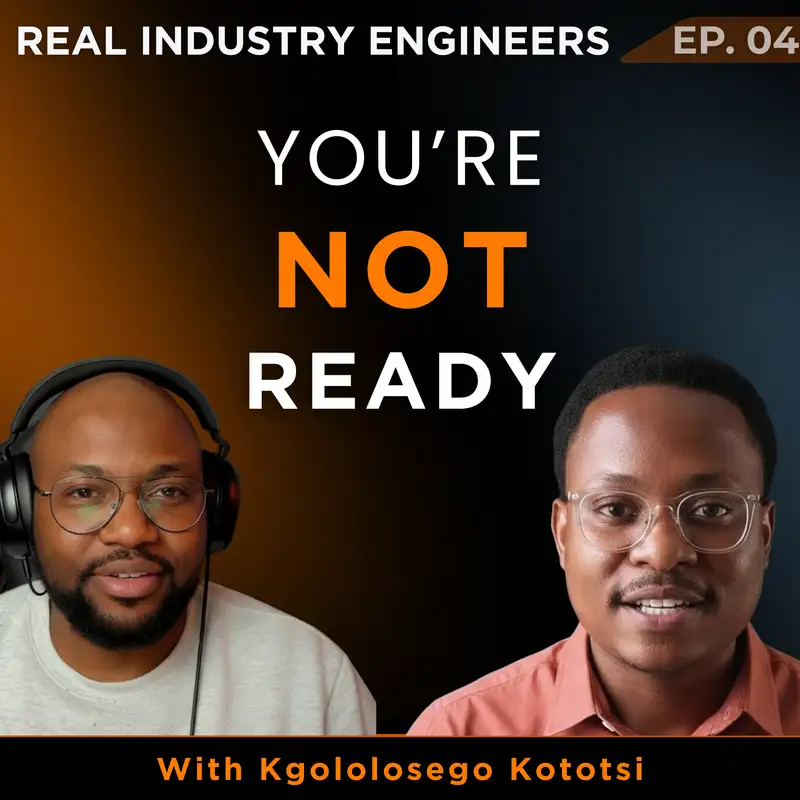
The Reality of Engineering Careers (What No One Tells You) | Kgololosego Kototsi | EP.004
Kgololosego Kototsi (00:00)
I think you can really get stuck in doing just knowing what you know and doing what you do.
But then at that time, I was giving too much time to my work and it was difficult to manage because an MEng in engineering control systems is not trivial.
when you graduate, you're man, it's still bad. You're rough around the edges and you still need more refining. And that's what industry starts doing
consulting speaks, we speak a different language there.
They trusted that I knew what I was doing. Even at times where I didn't know what I was doing,
So man, in the first year, was a lot of late nights, not sleeping, trying to figure out how things worked.
Nyasha Pawandiwa (00:37)
Yep, yep.
Mmm.
Kgololosego Kototsi (00:43)
I want to be the best engineer in my department, I'll do what needs to be done to achieve that, right?
Nyasha Pawandiwa (00:49)
Mmm.
Nyasha (00:56)
Hello and welcome to another episode of the Real Industry Engineers podcast where I get to talk to real engineers in the field.
doing the work. And I'm really excited today to be bringing you a conversation I had with Kgololosego Kototsi, ⁓ who is a lead control systems engineer at Yokogawa and a global leader in industrial automation and a registered professional engineer with the engineering council of South Africa or ECSA So I actually go way back with
KG we actually studied together back at the University of Pretoria or TUKS and this is a really great conversation where we go into our career journey and how things have been going so far so enjoy
Nyasha Pawandiwa (01:44)
Well, I guess we can start. Thank you so much for jumping on. It's been a long time. Studied with KG back at the University of Pretoria in, I think we graduated together in 2017. I think finished 2016. Yeah. So that's really excited. Really excited to catch up after a really
Kgololosego Kototsi (02:00)
Nyasha Pawandiwa (02:08)
really long time.
Kgololosego Kototsi (02:10)
firstly, thank you for having me, man. I think I'm very thankful for this opportunity to chat with you, chop it up after eight years, And I remember we used to be in the trenches together there doing those comms projects. yeah, ⁓ fun time.
Nyasha Pawandiwa (02:19)
Yeah.
Yep.
Yes.
guess I'll just start off by asking how things are going. in engineering. A question I always like asking people I started with is, you know, back in uni, you know, we had a perception of what industry is going to be like. And now that we've been working for, I don't know, maybe a good eight, nine years, do you really feel like Tuks prepared you for industry? Or you're like, give me my money.
Kgololosego Kototsi (02:41)
Mm.
Nyasha Pawandiwa (02:54)
I want to refund.
Kgololosego Kototsi (02:55)
No,
so,
it's been going good.
Eight and a half years in the game now, close to nine. I think the most important thing is especially coming back to the Tuks question and how it prepared me for
⁓ I would say that
think Tuks really taught me how to think more than anything. It taught me how to look at something.
Nyasha Pawandiwa (03:22)
Mmm. Yeah.
Kgololosego Kototsi (03:28)
digest it, think up a solution or really process my thoughts to get to an end result. And I think that's priceless. I might not be using OFDM anymore or all the other funny stuff that we learned, but in
Nyasha Pawandiwa (03:50)
Mmm.
Kgololosego Kototsi (03:54)
learning all of those things, I've managed to basically come up with a framework to say this is how I look at something, this is how I approach something, and this is how can get to a end result. So I definitely don't want my money back because I don't think I would have been able to package my raw talent into the finished product that I walked out of Tuks's doors.
Nyasha Pawandiwa (04:12)
Hehehe.
Kgololosego Kototsi (04:21)
And even then I wasn't really a finished product. Yeah, when you graduate, you're man, it's still bad. You're rough around the edges and you still need more refining. And that's what industry starts doing is that things aren't as cut and dried as it is in the textbook or with whatever small lab problem you have. There's just a lot of inputs to a problem. There's a lot of dependencies and
Nyasha Pawandiwa (04:22)
Yep, yep.
Yeah, yeah.
Yeah
Kgololosego Kototsi (04:48)
So that's why industry now starts coming at you and taking apart what you thought you know. But if you go back to the fundamental, which is to know how to think, then ⁓ things get better. Think what's time.
Nyasha Pawandiwa (04:51)
Mm.
That's beautiful, man. And I think I've had sort of the same experience. know, when you you I think I think when you start off in industry, you get a bit of a shock because things are Tuks is quite a controlled environment. You know, you go in like even those practicals, you know, the outcome is known, you know, the problem is well thought of. But in real life, you know, things are quite random, quite complex.
Kgololosego Kototsi (05:16)
Yes, yes.
Yeah.
Nyasha Pawandiwa (05:29)
You know, there a lot of dependencies, as you said, and there are a lot of other factors. I think one for me was standards, right? So I walked into industry and I'm hearing all these like, all these engineering standards and I'm like, what the heck? Like someone could have given me like a heads up, like there are all these standards that I need to now read and learn. of course, I think it's the challenge we have is, you know, in uni, they just have a really short time.
Kgololosego Kototsi (05:38)
Yeah.
Yeah.
BOOM
Nyasha Pawandiwa (05:59)
to get you ready, you so they try to get your fundamentals in place. And then the hope is later on when you start, you know, when you start working, things will sort of come to come together. Now that's, that's, that's good to hear. Well, I'll probably take a step back and to maybe before before uni, how or like why engineering, you know.
what got you interested into engineering and why not accounting or medicine or something like that? How did you come to be like, engineering is what I, I think that I wanna try out engineering.
Kgololosego Kototsi (06:26)
Okay.
Hmm.
I think for me, ⁓ I think STEM was always going to be what I was going to go into, because I had a natural affinity for math and science. So I did quite well at school in general. think I was well-rounded, but I liked the sciences and the mathematics.
subjects quite a bit extensively. So I think starting from high school, when I started high school, I didn't really know I was going to do engineering. I don't have I don't have the kind of story where I'll say that, yo, they used to buy me cars and I used to pick them apart. And I don't have that kind of story because I wasn't really I wasn't really a hands on person anyways. I just really knew how to study and understand things. when I started high school,
Nyasha Pawandiwa (07:03)
Yep. Yep.
Mmm.
Yeah, yeah, yeah.
Gotcha.
Kgololosego Kototsi (07:26)
There was a lot now, they start with these career things, picking subjects, and then you start having to think about what it is you're going to do. I had an influence from my sister, she used to do geography. So at first, I really liked geography, and well, with the math and the science, but then that fizzled out, and then I enjoyed accounting when I took accounting.
Nyasha Pawandiwa (07:35)
Mmm.
Kgololosego Kototsi (07:51)
I think what really jolted at the engineering thing, I attended a junior Tuckie camp. So Tuks used to hold these camps for grade 11s. they, yeah, so you'd go for a week. And then during that week, they take you, it was more focused on the math and science kids anyways. So they'd have classes for math and science. They'd have some career talks. And I think during that,
Nyasha Pawandiwa (08:03)
okay.
Mmm.
Kgololosego Kototsi (08:20)
trip is where the whole engineering thing really started to spark. That look, your talent in mathematics and science could be better utilized in the engineering field. ⁓ And now for the choice of coming to electronic engineering, when it hit me that, know, engineering is like what I really want to do, I could only just think of one of them.
Nyasha Pawandiwa (08:25)
Yep, yep.
Mmm.
Kgololosego Kototsi (08:45)
So, know, naturally you hear about mechanical. think mechanical is the most popular when you're young. it's all mechanical, fixed cars. ⁓ electrical engineers, work at Eskom. So when I started looking into it, I was like, man, I'm
Nyasha Pawandiwa (08:51)
Yeah, yeah, yep. Yeah.
Yeah, yeah.
Kgololosego Kototsi (09:02)
in the reason why cell phones work actually. And how do we get like the network connection and how does the laptop work and how do satellites work?
Nyasha Pawandiwa (09:06)
Mmm.
Yeah, yeah.
Kgololosego Kototsi (09:14)
How do, and at the core of every technology is a green circuit board, an integrated circuit in there. And those integrated circuits are developed by electronic engineers. So that
my driver to say that, I want to be in the center of all of this technology. Cars have it.
Nyasha Pawandiwa (09:36)
Yep, yep.
Kgololosego Kototsi (09:36)
trains have
it, medical devices have it. that's when I was like, it's either electronic engineering or nothing. When I made that call and even when I applied at Tuks it's the only engineering option that I had on there. I didn't select any other one.
Nyasha Pawandiwa (09:45)
Mm-mm. ⁓
Yeah, yeah, it seems like you had your your mindset from the beginning.
Kgololosego Kototsi (09:51)
Yeah, so...
Yeah, it was just like the way that a switch flips from zero to one. And then from there, I just knew.
Nyasha Pawandiwa (10:04)
Yeah, Now that's Interesting to hear. think everyone has got a different sort of journey of how they land into the engineering space. I think my story, similar to yours, but I didn't have as much research on what electronic engineering was. I sort of was like, ah, you know, I was kind of like curious. I was a little bit torn between electronics and electrical. And I was like, ah, you know, but I felt like electronics was more niche.
So it sort of was like, you know, I think I want to drill down in. Yeah, sort of it sort of looked good on paper until we started going into the trenches. And I was like, oh my goodness, what did I get myself into? And it was too late to turn back at that point. And I was just like, let me just. Yeah, I mean, but I'm glad I'm glad I pushed through and I'm sure you're glad to push through as well. And well, I guess one of the one other question I have is how did you find?
Kgololosego Kototsi (10:34)
Yeah
Yes.
I got Tim back.
Mmm. Mmm.
Nyasha Pawandiwa (11:01)
uni in general and this is probably the reason I asked this is that there are also maybe kids out there who are also thinking about you know doing engineering you know and it's always good to have someone who's sort of gone through the uni who's on the other side. How did you find that journey in general you know? Although from first year to final year of course just a brief overview for them.
Kgololosego Kototsi (11:10)
home.
Mm. Yep.
I don't think there's anything that really prepares you for university, You can come out of high school being like a top learner with seven distinctions and you get there and it's a whole nother beast. think university for me, I don't think I've ever learned as much as I learned.
Nyasha Pawandiwa (11:31)
Mmm.
Yeah.
Kgololosego Kototsi (11:52)
in that period of four years. That period of four years is where I did the most learning ever. I mean, we've been in school, when you get there, you've been in school for 12 years, but in those last four years, like, that's when you learn the most. So I think the important thing, especially for university, as challenging as it is, it's very enjoyable. I think...
Nyasha Pawandiwa (11:59)
Yep, yep.
Mm.
Kgololosego Kototsi (12:18)
If you're passionate about what you've chosen, if you're passionate about what you've chosen and you genuinely enjoy it, then it's a pain, but it's an enjoyable one. Because at the end of the day, when you look at what you've learned and what you know, like I said, it becomes priceless. The important thing, though, I think, in the university makeup,
Nyasha Pawandiwa (12:19)
Mmm.
Mmm.
Kgololosego Kototsi (12:42)
Man, networking is like having a group of people having a circle or just networking in general is what got most of us out of there unscathed because we had a network of people that we chat to. Like we used to work together on some stuff. You can't go through it alone. That's one thing I'll say that you can't, you cannot go through it alone.
Nyasha Pawandiwa (12:56)
Yeah, yeah.
Yeah. Yeah.
Kgololosego Kototsi (13:06)
I don't think there's anyone that goes through that journey alone and gets out of there sane yeah, having a proper network is key. But in general, it's very interesting part of your life where you're not in school anymore. You can decide when you go to class. You can plan your own day.
Nyasha Pawandiwa (13:12)
Yeah. Yep.
Kgololosego Kototsi (13:30)
Yeah, it's a whole different experience, but it's a good one and it's very worth it and it's very fulfilling, especially if you've chosen something that you're passionate about.
Nyasha Pawandiwa (13:42)
Nice.
Yeah, that's awesome, man. And I think you hit on a really good point around networking. mean, I don't know about other programs, but with engineering, when things get tough, man, you need to find people. There comes a time, like you might even try to do this thing by yourself, but there comes a time where you're like, man, I've got no idea what's going on here. I need to find out what's going on. And I think it's a really important skill.
Kgololosego Kototsi (13:56)
Yeah, you to talk.
Mm-mm.
Nyasha Pawandiwa (14:09)
especially for the day and age we're in now. They say your network is your net worth. And I think that's 100 % correct. The people you surround yourself with, even in industry, you know, the open opportunities, they, you know, it's all about who you know at the end of the day. And it's not like in a shady way. It's actually, you know, getting yourself out there, talking to people, meeting up with people, you know, that sort of thing. And I think it's something that we sometimes leave at uni, you know, we don't carry out.
Kgololosego Kototsi (14:15)
Yes.
Nyasha Pawandiwa (14:38)
But I think it's really, really important. Well, maybe talk us through how your career has been, some of the opportunities you've had since, you know, have you been working at the same place? Have you been working in different places? Some of the roles that you've managed to take up until now, sort of that post-uni, that post-uni part.
Kgololosego Kototsi (14:57)
Okay, just for additional context to start it off. So when I was at university, I had a bursary with Eskom But initially it was just like a merit bursary, just a scholarship where they'll take me through university. And then after that, we can let bygones be bygones and I can continue with my engineering career if I wanted to.
But come fourth year, I started to worry about employment opportunities. So then what I did was then I asked Eskom if I could convert it from a merit bursary into a contractual bursary so that they could absorb me as an engineer in training. So I did that interview again. Don't know why they wanted to interview us, but...
They did the interview and then I got my bursary converted to a contractual one. And then so after completing in 2016, February 2017, I joined Eskom on a power station, 6 February 2017. And I started there as a control and instrumentation engineer in training, because that's important.
Nyasha Pawandiwa (15:55)
Yep.
Kgololosego Kototsi (16:02)
And you know, there's the you go through the training program. have to now you're working at Eskom. It's a power generation facility. You need to go through all of the the different departments within the organization during your training. So we'll start off with the operators to gain an understanding of what the operators do, how they operate the plant, what's the operating philosophy.
Nyasha Pawandiwa (16:13)
Yep, yep.
Mmm.
Kgololosego Kototsi (16:29)
spend time there. After that, you'll do some maintenance work with the controlling and Instrumentation technicians, CNI technicians. Basically, in the plant, you calibrate, you maintain, you do preventative maintenance. And then after that, you move on to the engineering department. So the whole philosophy with that training is that you can't engineer solutions if you don't really understand operations and maintenance.
So they trust that you've learned engineering in university. So that's why when they start off with you, they start you off as an operator. You're there with the operators and you're writing the same tests that the operators write before they get appointed. And just to learn the process, how the process works from coal milling into the boiler, steam generation, turbine control.
Nyasha Pawandiwa (16:58)
Mmm.
Gotcha.
Mmm, mmm,
mmm.
Kgololosego Kototsi (17:17)
condensation and the whole process. So I spent 18 months there. I was part of that, basically part of that process. Basically learning, was just learning. There's a bit of arrogance when you come out of university that man, like I have this engineering degree and I'm here doing operations. And I trust it's natural because with all the five of us that joined that year, we all felt the same. It like, we just want to get into the...
We want to get into the engineering. want to go to the engineering department. This is a wasting time. But I think in hindsight, always rationalize it that just like I mentioned now that you can't engineer without understanding operations and maintenance. So yeah, man, I spent 18 months there. Eskom was going through some things at the time. So they went absorbing. They weren't absorbing people permanently.
Nyasha Pawandiwa (17:44)
Yep, yep.
Yeah!
Mmm.
Kgololosego Kototsi (18:10)
So all of the buses that they had, they were releasing. So this was 2018. Now in June, we get called to a meeting and they were like, guys, if you have an engineering degree, a diploma, we're gonna release you guys. We're gonna keep the operators in training, but you guys are gonna have to make a plan. And for me, that just like, it shook my world because at that time I'd already thought that, okay, I'm gonna be here at Eskom and...
working to the CNI ⁓ engineer position for the plant. And I really know this place. I've done the groundwork, like in the trenches there, doing things that I didn't want to do in the beginning before understanding what it was for. ⁓ And then it felt like 18 months lost, right? So yeah, people were starting to apply. They were like, it's fine.
Nyasha Pawandiwa (18:37)
Mmm.
Yeah, yeah, yeah.
Mmm.
Kgololosego Kototsi (19:01)
The work back period was actually two years for the bursary, but then they said, you know what, we can write it off. If you get a job now between your 18th month and the 24th month, we can just write off your Debt So then now everyone is scrambling. Everyone is looking for a job. Yeah, now I'm applying and we're there applying. And I got an opportunity with Yokogawa.
Yokogawa is an international industrial automation company. I first got exposed to Yokogawa while I was at Eskom because we had some oxygen analyzers that were ⁓ the Yokogawa brand. So one of my seniors ⁓ at Eskom, he let me know of a vacancy that he knew about at Yokogawa. So I tried my luck. I got called in for an interview.
Nyasha Pawandiwa (19:44)
Gotcha.
Mmm.
Kgololosego Kototsi (19:54)
And then, yeah, September the 3rd, 2018, I joined Yokogawa as a junior control systems engineer in the technical services division. Yeah, I mean, it's like, it just felt like they're giving me a chance after all of this uncertainty for three months applying for jobs and not sure if we're going to be jobless in February. was, so I got that opportunity at least. I Eskom, joined Yokogawa. Now Yokogawa is completely different.
Nyasha Pawandiwa (20:14)
Mmm.
Yeah.
Kgololosego Kototsi (20:24)
⁓ You're not in the SOE environment. Now you're working for OEM. You're not an end user anymore. Now you're an OEM. So all of these control systems solutions that you used to try to figure out or debug when you were the site engineer, now you become the person that starts writing all of that software. then, yeah, 2018 started at Yokogawa.
Nyasha Pawandiwa (20:33)
Yeah. Yeah. Yeah.
Yeah.
Kgololosego Kototsi (20:50)
fortunate to meet a good team. Start out as a junior engineer, like I mentioned, and projects came. Now it's maneuvering, it's now maneuvering the life of OEM, vendor. Now it's traveling involved, meeting different clients and liaising with different people. it becomes a whole different thing. So then,
Nyasha Pawandiwa (21:09)
Yeah.
Mmm.
Kgololosego Kototsi (21:18)
Yeah, I had a good couple of years there initially at Yokogawa. I got promoted then in 2020. I'm in the heart of COVID. After a project that did for Columbus, Stained Steel out in Middletown. ⁓ Yeah, I think that project is one of the, like a key stone project in my career. I don't think I'll ever forget that one.
Nyasha Pawandiwa (21:29)
Hmm.
Kgololosego Kototsi (21:43)
because of how it stretched me as an engineer. It stretched me. So then I got recognized for that one, got promoted to intermediate level. And then just push, man. I think the key thing for me was to always be the best version of myself or the best engineer that I could be. So I just kept pushing. 2022, I promoted again to senior engineer. At the same time, I...
Nyasha Pawandiwa (21:46)
Hmm.
Mmm.
Kgololosego Kototsi (22:13)
During that same period, the same year I got my ECSA Registration so I became a PREng as well. had finished my reports. So I became a PREng as well. Yeah, and then from there, I spent a couple more years with Yokogawa. And then I parted ways and left for... in 2023, I went to Accenture.
⁓ and now it was, it was a completely different way of doing business. was in the consulting field now. And I wasn't, I was no longer doing pure industrial automation. Now it was more on the, if you look at the automation
Nyasha Pawandiwa (22:48)
Mmm.
Kgololosego Kototsi (22:54)
now I'm sitting on a level higher than the control layer. Now we're trying to look at, cybersecurity. We're trying to look at data analytics and how, we can leverage data that comes from.
Nyasha Pawandiwa (22:57)
Yeah.
Kgololosego Kototsi (23:06)
our operational technology. And then
was involved in a project, a mine build project. They spent about a year. then things happened. I moved back to
where now I'm a lead engineer. Where I'm now a lead engineer. Yeah, back to doing the nitty gritty on site again.
Nyasha Pawandiwa (23:20)
Yep, yep.
Yep.
Kgololosego Kototsi (23:30)
yeah, so that's basically a natural of how my career developed from 2017 to 2025. I've been back with Yokogawa for about a year and two, three months now. It's been good.
Nyasha Pawandiwa (23:41)
Wow.
jeez, even just listening to that, I can see it has been quite a dynamic career going through different roles. And I think it has been really good, especially like in automation. And we'll talk a little bit more around automation because I'm sort of in that field as well. But it's quite interesting how you moved from the different, I guess,
Kgololosego Kototsi (23:52)
Mmm.
Nyasha Pawandiwa (24:10)
within from, guess,
Because when you're talking about in in Eskom I can imagine that you guys were really on the, you know, in the trenches, you know, really using the stuff. out imagine, for instance, but this is yeah, you're the instrument side. So actually using you actually seeing, you know, sensors and you're seeing, you know, you're collecting data and you're like, ⁓ man, we're not getting this reading from this sensor. What's going on? So is it the cable? Is it this? So you're really on that level, you know.
Kgololosego Kototsi (24:22)
on the instrument side.
Hmm.
Mmm.
Mmm. Mmm. Mmm.
Nyasha Pawandiwa (24:41)
And it's interesting because in automation, we've got this thing, the automation hierarchy, where you go all the way up to MES, you know, and that's sort of like, I feel like you've had that full experience where you go on the different layers to see and have had the opportunity to work in the different roles. So it's quite interesting. And I also think,
Kgololosego Kototsi (24:47)
Yep. Yes.
Mmm.
Nyasha Pawandiwa (25:01)
I might be biased as a Tuks alumni as well, but I think Tuks sort of stretched us to be able to fit into
sort of any sort of environment yeah it's interesting and it's really exciting to hear and it looks like the the future for you looks quite bright so I'm really excited to see I'm always checking how people are going on LinkedIn and I'm like jeez this really exciting and I was like touching base so I've sort of been seeing
those sort of moves that you've been making. So it's been really, really exciting to watch. Maybe I'll probably take you back to the time where you initially joined Yokogawa and how that transition was for you moving from, you know, from the operator side to OEM. I think OEM have got really different processes and the way they do things is really different. I work for an OEM now and different kind of OEM, but you've got a lot of different...
Yokogawa is quite large, the way I know it. It's a global company. How was that transition for you? I know Eskom is large as well, but how was that transition? How did you find it? Did you find it a bit intimidating? Because you hadn't been doing engineering for about a year and a half, and now you're coming in a different environment. How did you find that transition?
Kgololosego Kototsi (26:10)
Mm.
Yeah, yes. ⁓ I like that you asked that because I was scared actually. remember when I joined, I think the first month I was scared because...
Nyasha Pawandiwa (26:31)
Mmm.
Kgololosego Kototsi (26:32)
It's a totally different environment. Like I'm not an end user anymore. With an end user, especially where I was in my career, there's, you know that there's, have like your OEM will still support you. There's things are there. I mean, it's a different environment where now you're solely responsible for taking care of the system. You're responsible for delivering all of these projects. You're supposed to know now.
When an end user picks up the phone and asks for support, you are the guy that has to know. So I think the transition ⁓ was quite an interesting one because now I have to go to, okay, I'm not really a generalist anymore as an end user. Like now I need to specialize. Like now I really need to know Yokogawa, Yokogawa's DCS.
Nyasha Pawandiwa (27:05)
Mmm. Yeah.
Mmm.
Kgololosego Kototsi (27:23)
all of Yokogawa's systems, need to familiarize myself with the processes, how they run projects, what standards they use. And I mean, being an OEM now puts you in a very different environment because it's not just like you mentioned, it's not just about the instrument, maybe it's the cable or maybe we need to bleed off the impulse line because the pressure is high, but there's nothing, there's no fluid passing through the pipe, just bleed off the instrument.
It wasn't like that anymore. And now it's more of like, there's IT now involved. Now I need to understand servers. I need to understand platforms. I need to understand networking. And there's all of these new things that I need to learn at the same time. So it was, yeah, was hectic, I think. But what I like about Yokogawa, like the...
Nyasha Pawandiwa (27:59)
Yeah.
Kgololosego Kototsi (28:11)
They trusted that I knew what I was doing. Even at times where I didn't know what I was
I think the important thing for me, and I always say this is that
Nyasha Pawandiwa (28:19)
Mmm.
Kgololosego Kototsi (28:22)
I've always tried to be the best. I have an inherent competitive nature and it doesn't have to be with anyone else. ⁓ But even just with myself, I want to be the best of...
Nyasha Pawandiwa (28:36)
Yep. Yep.
Hmm.
Kgololosego Kototsi (28:43)
Yeah, the best version of myself at that point in time. So if I was like, okay, I got to Yokogawa and I want to be the best engineer in my department, I'll do what needs to be done to achieve that, right? So man, in the first year, was a lot of late nights, not sleeping, trying to figure out how things worked.
Nyasha Pawandiwa (28:54)
Mmm.
Yep, yep.
Mmm.
Kgololosego Kototsi (29:07)
spending nights inside manuals, just to lay the foundation, get myself out of that end user thinking and put the OEM cap. Now I need to be a custodian for the product. When I put on my Yokogawa PPE, they look at me and they say, this guy knows this thing. So it requires a bit of a shift in the thinking, which was challenging, but also very
Nyasha Pawandiwa (29:10)
Yeah.
Mmm.
Yeah, yeah.
Yeah. Yeah.
Kgololosego Kototsi (29:31)
Yeah, it's a rewarding move. I remember I was gutted at the fact that Eskom didn't really take us on at the time. But in hindsight, me moving over to an OEM environment was the best thing that could have happened to my career, as it stands.
Nyasha Pawandiwa (29:41)
Hmm.
Nice, I think you really went to the parts I was really asking about because I think there can be a little bit of a imposter syndrome coming in when you go into a new environment and there are people there who know their stuff, who've been there for years, many, many, many years, and you're sort of coming in and you're sort of trying to navigate that. So, and I think you really...
Kgololosego Kototsi (30:00)
Mmm.
Mm. Yeah.
Nyasha Pawandiwa (30:13)
took on the challenge, you know, we're like, you know what, I'm gonna put my best foot forward and I'm gonna study. And you know, when you're, when you're on OEM side, you can't, you can't, you can't really escalate to anyone else. You you are the guy because the guys at the, who are using the stuff have already done their fair share of troubleshooting and they've already tried to get things working to a certain extent. So by the time a problem comes to your desk, it's quite a mature problem because
Kgololosego Kototsi (30:33)
Yes.
Nyasha Pawandiwa (30:41)
A few people have had a crack at it and been like, you know what, we don't know what to do. And then they've escalated it to you. So I think it's one of those things where you really need to go in. It reminds me of, you know, back in the day when we're doing our EMK and we're reading through these data sheet and you have to go into the details of registers and be like, no, you can't use this register because it does this and this one is this big. And, oh man, it's like really
Kgololosego Kototsi (30:57)
Yeah.
Amen.
Yeah.
Nyasha Pawandiwa (31:10)
going into the details and I really felt like you really stepped up into the challenge with that same sort of approach of, know what, if I could figure out, you know, all those things and I guess we're not foreigners to late nights and getting things done. Sometimes you need to really just, you know, get it done.
Kgololosego Kototsi (31:20)
Mmm.
No, no, and that's,
and that's, and that's the thing, right? I our, our training, like, has already instilled certain things. And I, I'm a firm believer of like, I can find, I can find it in the manual. So I'm always the guy and it's all something I always preach is like, just read the manuals. If you read the manuals.
Nyasha Pawandiwa (31:37)
Mmm.
Yeah.
Kgololosego Kototsi (31:51)
⁓ Something in there will... It's there, it's in the manual.
Nyasha Pawandiwa (31:52)
It's there. ⁓
Kgololosego Kototsi (31:56)
That's always been my thing.
Nyasha Pawandiwa (31:58)
Yeah, I think it's definitely, I share the same sentiment. It's always in the data sheet. It's always been in the data sheet. It's just need to find it. nice. Yeah, just need to go looking. And I think when you start trying to make shortcuts, that's when things fall apart. It's just going line by line, just really going into the details. Yeah, that's great to hear, And well, I'll probably move a little bit.
Kgololosego Kototsi (32:08)
Always been there, man.
Yep.
Nyasha Pawandiwa (32:26)
away from that and ⁓ into your masters. So you've decided to go back, back to Tuks to do a bit more for the studies. What is sort of motivated you to do that? And maybe you can walk us through sort of what your masters is in and how you came about that decision to be like, you know what? I need more. I need more. I'm going to go back, back to school.
Kgololosego Kototsi (32:49)
Yeah. Yeah. So I actually went back for my honors in 2019 and 2020. I was with the Control Systems Group with Prof. Craig and Prof. Derek Leroux. So I was focused more on process control at the time. Like I love process control with everything that's in me. So was like, I'm going to do an honors on this. And yeah, I did that two years done.
Nyasha Pawandiwa (32:58)
yep.
Mm.
Kgololosego Kototsi (33:17)
I started my Masters in Process Control still with Prof Derek. But then at that time, I was giving too much time to my work and it was difficult to manage because an MEng in electronic engineering control systems is not trivial. it's hectic So at that time I had to make the decision, like, you know what, is it
Nyasha Pawandiwa (33:28)
Mmm.
Kgololosego Kototsi (33:41)
Is it doing this MEng sacrificing a bit of work or is pushing through the work? And I was like, at this, at my current time in life, I need to just make sure that all my attention goes to the work. And then, yeah, I never really completed that. But then last year, I, then decided again, I'm like, you know what, I think I'm, I'm just a fan of learning in general. And my brain that time I was
Nyasha Pawandiwa (33:50)
Mmm.
Kgololosego Kototsi (34:08)
I was at Accenture in the consulting space. now consulting speaks, we speak a different language there. It's more on strategy. It's more on, it's not just about, let's get this thing to work and then it works, then we maintain it. It's okay. It's more about like, how does this technology start to enable data-driven decision-making?
Nyasha Pawandiwa (34:09)
Mmm, mmm.
Yeah.
Kgololosego Kototsi (34:31)
this technology, how does it form part of your data strategy? Like, are we looking at emerging technologies and how we can use that and really going into the depths of like the industry 4.0 and all of the technologies that come with it, right? So then at that time, I had a colleague of mine, he was also studying, also at Tuks he's masters and he was like, you know what?
Nyasha Pawandiwa (34:32)
Mmm.
Kgololosego Kototsi (34:55)
I'm doing this program and whatnot, it was telling me about it and I had seen it and I was like, you know what, I'm gonna look at this thing. And I went in with a Master of Engineering in Technology and Innovation Management. I think basically because I know that technology is an enabler and...
Nyasha Pawandiwa (35:18)
Mmm.
Kgololosego Kototsi (35:20)
Yeah, it's an enabler. if we, if we strive towards innovation, we don't, there's no limit to what the technology can enable from a business perspective. So I actually wanted to now start putting on my strategic and managerial hat, because once you cross the like six, seven year mark in your career, now you, you realize that the stuff, the stuff that you're doing is
Nyasha Pawandiwa (35:29)
Yep. Yep.
Mmm.
Kgololosego Kototsi (35:44)
fits into a much bigger picture than just getting a pump to run. So that's why I actually went with that. Yeah, it's been a good experience. My research currently, I'm looking at organizational readiness for business intelligence and analytics. looking at how easy is it to adopt these technologies.
Nyasha Pawandiwa (35:49)
Yep, Mm, mm, mm.
Kgololosego Kototsi (36:13)
but in the production and manufacturing industries. So I'm not staying away from what I know, because I mean, business intelligence is business intelligence and finance, business intelligence everywhere. But I'm trying to get it from a production and manufacturing lens to say that production and manufacturing has its own problems, right? It has its own sort of like organizational challenges and
Nyasha Pawandiwa (36:16)
Mmm.
Kgololosego Kototsi (36:37)
amidst all of those challenges, how easy is it to adopt this technology in this context? So yeah, it's been going good, Actually, my supervisor actually presented a paper that we wrote just looking at ⁓ the conceptual model for looking at the specific antecedents or factors that drive
Nyasha Pawandiwa (36:37)
Mmm.
Kgololosego Kototsi (36:58)
or enable the adoption of business intelligence in the context of South Africa. So he was in America the start of this month. So he presented that paper. I couldn't go, unfortunately. It would have been nice to present it myself. But as my supervisor and co-author, he presented it on my behalf. So it's been going good. And to actually publish before finishing my research is actually another feat.
Nyasha Pawandiwa (37:12)
Mmm.
Yeah, yeah, yeah. I was going I was going to say that's that's that's huge, man. I think if Tuks is the Tuks that I know they are big on research and publishing is such a big thing. At Tuks and I think you've done you've done really well in that. It's not easy navigating studying and and working at the same time. I take it to, of course, doing your masters by research.
Kgololosego Kototsi (37:55)
Yeah, so it's half and half. It's coursework and there's a mini dissertation. with the Graduate School of Management, yeah, that's how they divide it. It's half coursework and then half the mini dissertation.
Nyasha Pawandiwa (38:01)
Gotcha.
Mmm.
That's awesome, man. I was about to say, because I think, especially when you're in industry, research is good, but I think it targets more academia sort of pathway. And I think having that coursework can just give you information. Sometimes they just give you, just like the good old days where they just tell you, this is what's going on, here's the information. I say this from, so when I was in...
Kgololosego Kototsi (38:19)
Mmm.
Nyasha Pawandiwa (38:36)
I think it was 2021. I did a master's in industrial automation. So what happened with me was I I done of course. ⁓ electronic engineering at Tuks and then I did my Honours So of course, when we finished, we were all in the telecommunications group because everyone was like, let's do telecommunications so that we can pass. And then everyone was like, let's just.
Kgololosego Kototsi (38:43)
Industrial automation,
Hey man, we love telecoms.
Nyasha Pawandiwa (39:01)
let's go do coms. So we all went to do coms, right? And then I'm pretty sure none of us are working in coms now. But anyways, that's that that was our strategy. So I did that. and I enjoyed it. I enjoyed it at the time. But then, of course, I got into industry and then I wasn't in a plant.
Kgololosego Kototsi (39:10)
None of us.
Nyasha Pawandiwa (39:21)
I was more like in machine control. Right. So.
Industrial machinery, is totally, totally interesting field, quite, quite different, a lot of similar challenges, but different standards, different set of challenges, that sort of thing. So I walked in, I came in with my knowledge, finite state machines, yada, yada, yada, and I was like making machines move and stuff. So everything was working fine, but I was like, geez, I actually don't know what industrial automation is about. Like, I just want to understand the field from a, from a fundamental level. And then I did my
Kgololosego Kototsi (39:34)
Hmm.
Mmm. Mmm.
Nyasha Pawandiwa (39:54)
Masters in Industrial Automation and that was really great because they just laid everything down from okay, this is industrial automation. This is where it's going, you know, and it was really great because it just gave me a good overview. Of course, you know when you're given a PLC can just you can just
it out. You know what mean? But you want to really understand like even all the safety stuff and just really understand which standards you need to be looking at and get really good to the fundamentals. So that was really really great. So
Kgololosego Kototsi (40:12)
Mm.
Nyasha Pawandiwa (40:23)
I was going to say, I think the reason I'm bringing it up is I think masters by coursework with that, I guess capstone thesis at the end, that research component, I think is a really great balance for if you're in industry, because you can just get information. Sometimes all you need is just information. And then research gives you those research skills. of course, you have done your honors. So you are good at doing research in general, because honors, do all that.
Kgololosego Kototsi (40:36)
you
Yes.
Nyasha Pawandiwa (40:52)
that I did my honors. I did my honors in Tuks as well. You you've got all those weird modules you're doing and you're doing all these literature reviews and weird things like that. So it really gets you, you you know how to look for a good source and get good information, which is what you really want to do. You know how to write it up, but you don't want to spend your whole time just doing that. You know, sometimes you just want to just get more information onto yourself so that you can get things done in industry. So that's
Kgololosego Kototsi (40:55)
100%.
you
Nyasha Pawandiwa (41:22)
Really great. think the next question I would have for you around that would be how have you seen yourself studying? How have you seen that impacting your work? know, are you seeing because I think there's this thing of when you do this, there's some guys who do like bachelors, honors, masters, everything's like back to back to back to back to back, you know, and then there are guys who like go into industry and then they sort of see
where their career is going, then they come back and do something that they really feel is relevant to where they're going. Have you started to see changes or have you started to seeing impact of what you're studying, the work you're doing outside of work? Have you started to see that influencing? Of course, you're not yet done with your masters, I take it. But have you started to see things sort of shaping up because of the work you're doing?
Kgololosego Kototsi (42:15)
100%. I think, like I mentioned, that the nice thing about this master's is that it helps you, it gets you talking the language. That our solutions aren't just solutions for a single purpose. There's a bigger machine where all of these small cogs and sprockets fit into.
Nyasha Pawandiwa (42:26)
Mmm.
Kgololosego Kototsi (42:35)
And that bigger machine is the business. And when we are looking at how we're driving the business forward, there's a lot of us that are part of the puzzle pieces in driving the business forward, right? So I think what the most is done for me is that it allows me to speak the language now. when I look at certain pieces of work that I do,
I can now rationalize it to say that this is looking more like ESG. Like now, this is ESG work because we're trying to comply with minimum emission standards. This is actually ESG work that we're doing because a particular company's strategy is now aligned with ESG. And we know that ESGs are apparently trending.
Nyasha Pawandiwa (43:12)
Mmm...
Kgololosego Kototsi (43:24)
We're all looking at the environment, trying to be sustainable. And all of these small projects start springing up and you realize what part you play in terms of driving the business strategy forward. So if it's ESG, if it's technology enablement, if it's data-driven decision-making, it has helped me now really be fully conversant with those teams.
Nyasha Pawandiwa (43:24)
Yep, yep.
Mmm.
Mmm.
Kgololosego Kototsi (43:47)
and align my work to have certain discussions with clients to say, but now if we're trying to open up a data pipeline with all of this OT data that we have from the control system, maybe we should start looking at cybersecurity. If you guys are all of a sudden now hopping from your ⁓ organization, laptops through the IT network into the control system and we have no firewall there,
Nyasha Pawandiwa (43:49)
Mm.
Mmm. Mmm.
Kgololosego Kototsi (44:14)
that essentially
harms the business because now they can start harvesting your information. I mean, it's all of the technical things that we already know, but just opening yourself up to look at it from a business perspective. I think you can really get stuck in doing just knowing what you know and doing what you do. Like I know how to get a Plant up and running and that's all I care about. But is the work I'm doing
Nyasha Pawandiwa (44:27)
Mmm.
Kgololosego Kototsi (44:40)
Is it sustainable? Apart from safety, obviously, as engineers, we'll always look at safety. Especially being a registered professional, you don't want to mess around with safety because now certain decisions you make will, you will be liable for. But now we're looking at sustainability, we're looking at driving company strategy, technology strategies, data driven decision making, and all of these sort of like high level themes that weren't really.
Nyasha Pawandiwa (45:03)
Mm.
Kgololosego Kototsi (45:06)
visible to the naked eye for me.
Nyasha Pawandiwa (45:09)
Mmm, mmm, mmm, mmm, yep.
Kgololosego Kototsi (45:10)
So yeah, so I
would say that the master's has enabled for wider sort of thinking.
Nyasha Pawandiwa (45:16)
Yeah, that's that's awesome. And I think a lot of a lot of I think the strategy you've taken here is really, really impressive. I think a lot of guys end up going for that either for that MBA or master's in engineering management to try get that high level view of which which is I think is a good strategy as well. But I really like your approach because you've taken a unique approach. We still
Kgololosego Kototsi (45:31)
Mmm.
Nyasha Pawandiwa (45:42)
leans into your technical strengths, right, while starting sort of to widen your borders a bit and sort of widen your scope to be like, okay, I'm now able to also consider these other things. So that's really, really exciting. I'm really so when I when are you finishing your your masters?
Kgololosego Kototsi (46:00)
I submitted my draft report on the 10th of August. So I'm just waiting for feedback on that. then after that, I'll submit my final report in October and then yeah, it's done.
Nyasha Pawandiwa (46:07)
yeah?
⁓ nice man. yeah, we'll consider it done then because that's just the bulk of the work has been done already. I will say congratulations on your masters, although it's not official. yeah, it's always exciting to see things happening. I think doing a masters at this stage, it's not really about the piece of paper at that stage, you know.
Kgololosego Kototsi (46:23)
Yeah.
Yay!
No.
Nyasha Pawandiwa (46:41)
It's really about equipping yourself. think undergrad is mainly about the piece of paper. You're just thinking, man, I just need to graduate. I just need, I just need something, you know, but when you get to that sort of advanced stage in your career, you're also thinking about your impact. You know, you're sort of thinking about, you know, I really want to know what I'm doing. I really want to direct my career in the right, in the right path. So I'm really excited for that. Well, one more topic maybe I want to jump into. I know I want to be respectful of your time as well.
Kgololosego Kototsi (46:53)
No.
No.
Nyasha Pawandiwa (47:10)
is this whole concept of, because you've been talking a lot about business systems and this whole idea on, know, engineers being involved in those sort of conversations, you know, and you mentioned earlier talking about, you know, when you get to that four, five, six year mark, seven year mark, you're sort of starting to think, ⁓ do I really want to be, you know, coding the rest of my life or is there more I want to be involved in? That's sort of
Kgololosego Kototsi (47:36)
Yeah.
Nyasha Pawandiwa (47:39)
guess everyone gets to that point of like, man, is this, is this what I want to be doing forever?
Or, you know, how are you, how are you sort of navigating those sort of thoughts? What are you sort of thinking about for the future? You know, is, you know, and there's nothing, I think I will also preempt saying, um, there's nothing wrong with going drilling into the technical because there's some guys who really go for the technical side of things. And it's really, really great.
Nyasha Pawandiwa (48:05)
So I think my question coming up was, what are you thinking around that? Is that sort of where you want to head? Or you're thinking more, let me drill into more into technical. I really want to know what's happening under the hood and I want to keep going down with technical, which is there's nothing wrong with that as well. You know, there's no right answer. I think that's the thing.
Kgololosego Kototsi (48:27)
Yeah.
Nyasha Pawandiwa (48:27)
One thing
with career, right? There's no right answer, but I'm quite interested to see what's where your head space is at in terms of that.
Kgololosego Kototsi (48:37)
I've even coined a name for it. It's like the late early career conundrum because like we were basically at the end of our early careers. Essentially, it's we wouldn't say it's really mid career because careers are long. But at the end of our early career, once we jumped the once we jumped the eight year mark approaching 10 years, they're now like you're a seasoned professional. Right. And
Nyasha Pawandiwa (48:47)
Yep.
Mmm.
Yep, yep.
Kgololosego Kototsi (49:08)
This question is always something that I think about, like even when I did this masters or decided to do this masters, I felt like I wanted to gear myself to start thinking in that way. I believe it's important. I currently don't have an answer to it. ⁓ I don't have an answer to it. I like I like being under the hood in the trenches. But at the same time, the.
Nyasha Pawandiwa (49:09)
Yeah, yeah.
Mmm.
Yep. Yep.
Mmm, yep.
Kgololosego Kototsi (49:38)
looking at everything from a holistic perspective and not just one central part is also something that intrigues me because I mean, ⁓ that's the managers sit. They decide to release Kpex for projects. Like this is a strategic enabler. We're doing this project instead of this one because this is what we're going for. And ⁓ that's sort of like the
Nyasha Pawandiwa (49:54)
Hmm.
Yep, yep, yep.
Yep.
Kgololosego Kototsi (50:09)
That's where the differences sit. So we can either go become a technical specialist and really know, like you said, what's under the hood and like code and be on site to we hours commissioning a plant or you could go the other side. for myself, really don't have an answer to that. I'm still looking for it. ⁓ Currently, I'm just trying to position myself for either one.
Nyasha Pawandiwa (50:13)
Mmm.
Yep.
Yep, yep.
Kgololosego Kototsi (50:39)
⁓ as soon as I know which one is, is, is, is the right part for me to take, I think I'll know, but then I'd be well equipped with both because I have, I have years of technical acumen and I've also done this masters that now gives me the business, the business lens of everything. So, I'm equipped to.
Nyasha Pawandiwa (50:41)
Yeah, that's good.
Yep. Yep.
Mmm.
Kgololosego Kototsi (51:08)
to go into either. And I believe in trying stuff out. You can try it out and look at engineering management or whatever. And if you don't like it, you just go back to lead engineering again, which is also sort of like a bit like management because especially from where I sit ⁓ in my department, I basically sit with the
Nyasha Pawandiwa (51:20)
Yeah.
Yep, yep.
Hmm.
Kgololosego Kototsi (51:36)
most senior people in the department. And when certain decisions or causes of action are being discussed, I am in those conversations, although I'll still have to be on site to go commission a boiler, for example. So yeah, think I'm currently liking the
Nyasha Pawandiwa (51:53)
Yep. Yep. Yep. Yep. Yep.
Kgololosego Kototsi (51:57)
hybrid nature of what I'm doing because I get to see certain things from a management perspective, ⁓ but also still do the fun stuff.
Nyasha Pawandiwa (52:08)
Mm-hmm. That's that's I think that's a really great position to put yourself in because and also I think that does a really great point in terms of trying things out and I think a lot of people you know, they just don't try things out because they just have a Perception say oh, this is what I want to do. This is what I've always wanted to do now I was talking to a friend of mine who was sort of sharing, you know, I don't really feel passionate about you know this What I'm doing now
You I don't
passionate. don't know how I can get passionate again. And I was like, you know what? You don't have to be passionate about the same thing your whole life. Like your interests can change, you know, and and I think there's nothing wrong with that. You know, you can be like, you know what? At the beginning of my career, I really like this. But I got bored. You know, people get bored all the time and you can move. And I think that's part of growth and development. And, know.
Kgololosego Kototsi (52:44)
No, yeah, no, your interest can
Nyasha Pawandiwa (53:01)
making things interesting for yourself. So I'm quite interested to see how you navigate things in the future, but I think you've really put yourself in a position where you can have a taste and a feel.
for both and of course you've spent a lot of time within the technical side and I think you know for a fact that the technical stuff you know is stuff you are comfortable with you've been doing it for a while you know if someone gives you a technical problem you've already got a plan you know like even if you don't
what's going on you know how to know what's going on you know what I mean but when you then go into the business side you might not have that much yet
Kgololosego Kototsi (53:32)
Yes, I like that.
Nyasha Pawandiwa (53:38)
But you're sort of starting to creep into it slowly whilst you still hold on to your strength, which is really good. A few more questions I like putting towards the end. One.
⁓ It's just going to be two just because of time. But one is if you weren't an engineer, what would you be doing
Kgololosego Kototsi (53:59)
Man, I was good at math. It's a tough one. Okay, so there's two many facets to that question, right? If I was an engineer and survival or money wasn't a problem, because I have different answers for different scenarios. I have different answers for different scenarios. So like if I wasn't an engineer and
Nyasha Pawandiwa (54:01)
That's a tough one. It gets people all the time. Yep.
Yeah.
Yeah.
Yeah, yeah, yeah, yeah, I get it, I get it.
Kgololosego Kototsi (54:29)
like I could make what I was making regardless of what I'm doing, then my answer would be different. just looking at my second choice, because Tuks obviously forces you to do something else, I think I would have gone into actuarial science. I probably would have gone into actuarial science and then
Nyasha Pawandiwa (54:38)
Mmm.
Mm.
Mmm.
Kgololosego Kototsi (54:55)
that probably would have like integrated with like data science and because that's a that's a field that I'm really enthusiastic about machine learning and algorithms and modeling data modeling. ⁓ So it's probably would have been actuarial science that would have been mixed up with data science. It's I mean, it's not like I can't do data science or whatever now, but I think the actuarial side of it because I was really good at mathematics and it was my second choice when I was
Nyasha Pawandiwa (55:01)
Yeah.
Yep, yep.
Kgololosego Kototsi (55:25)
when
I apply to tuks in any case. So that's probably what I would have been doing if I hadn't become an engineer.
Nyasha Pawandiwa (55:30)
Yeah, that's it.
That's the-
that's an interesting choice. I've got a friend of mine who did Actuarial there by tuks Geez. Yeah, yeah, we were doing sleepless nights. I think they were doing quite intense, intense stuff, intense proofs and things like that. And then they do. Yeah, it's intense.
Kgololosego Kototsi (55:50)
Yeah, it's proofs. ⁓ All of these theorems.
Nyasha Pawandiwa (55:53)
man, this has been this has been really, great. I enjoyed having the chat.
catching up after such a really, really long time. Really excited with how you've sort of navigated the complexities of career. And of course, there's always life and curve balls and everything. So you're doing a really, really great job. And I'm really excited to see also I saw that you are also involved with ECSA as well. I didn't even get to talk about that. So
Kgololosego Kototsi (56:15)
yes.
Nyasha Pawandiwa (56:17)
Yeah, I'll probably gonna be probing you very soon for a part two to this interview as well. I think we've got a lot to cover also because, you know, we also studied together. So we've got a really good history as well. But I won't hold you up for much longer. But finally, if people want to connect with you, if they want, if they've been excited by any of the stuff we'll be talking about What's the best way to get in touch with you?
Kgololosego Kototsi (56:40)
Yeah, I think the well-known platform, LinkedIn, if you search my
Kgololosego Kototsi you'll find me. I respond to direct messages very quickly. I get them quite a bit. There's ⁓ people asking for career advice or, yeah, there's always something in those direct messages and I'm always open to help someone that has the
Nyasha Pawandiwa (57:07)
Yep.
Kgololosego Kototsi (57:09)
If someone has the confidence to ask, ⁓ I'll always help because I believe mentorship is important. And yeah, so you can find me on LinkedIn. Yeah, I don't have a Twitter account. LinkedIn.
Nyasha Pawandiwa (57:14)
Yep.
Creators and Guests